Before AI, Find the Workflow Leak | Neural Edge AI
Before AI, Find the Workflow Leak | Neural Edge AI
Before AI, Find the Workflow Leak | Neural Edge AI
April 29, 2026•3 min read
AI readiness for construction firms is not about technology. It is about operations. Before a construction firm adds any AI tool to their workflow, three questions need clear answers: where is time being lost, where is documentation breaking down and where are decisions taking longer than they should. Those answers determine whether your firm is ready to use AI productively.
What AI Readiness Actually Means for a Construction Firm
Most AI readiness frameworks are built for corporate environments with dedicated IT staff and standardized data. Construction firms do not work that way. Your projects are temporary. Your teams change. Your documents live in email, spreadsheets, PDFs and field notes.
AI readiness for a construction firm means something specific: your core workflows are documented well enough that an AI tool can act on them consistently. If your RFI process runs differently on every project depending on who the PM is, an AI tool applied to that process will produce inconsistent results.
That is not a technology problem. That is a process readiness problem. And it is fixable before you spend a dollar on software.
The Three Areas Where Construction Firms Are Least Ready
1
Document Management
Most construction firms have documents spread across multiple systems with no consistent naming, filing or retrieval process. Submittals, RFIs, change orders and daily reports each have their own informal system, often built around individual PM preferences. AI tools require consistent inputs to produce consistent outputs.
2
Communication Routing
Information in construction operations frequently gets stuck between field, office and subcontractors. The delay is not always about speed. It is about knowing who needs what information and when. AI can accelerate communication routing but only if the routing rules are defined first.
3
Reporting and Accountability
Weekly reporting, safety logs and project status updates are often compiled manually from multiple sources. This is time-consuming for PMs and produces reports that look different from week to week. Standardizing the inputs is the prerequisite for automating the output.
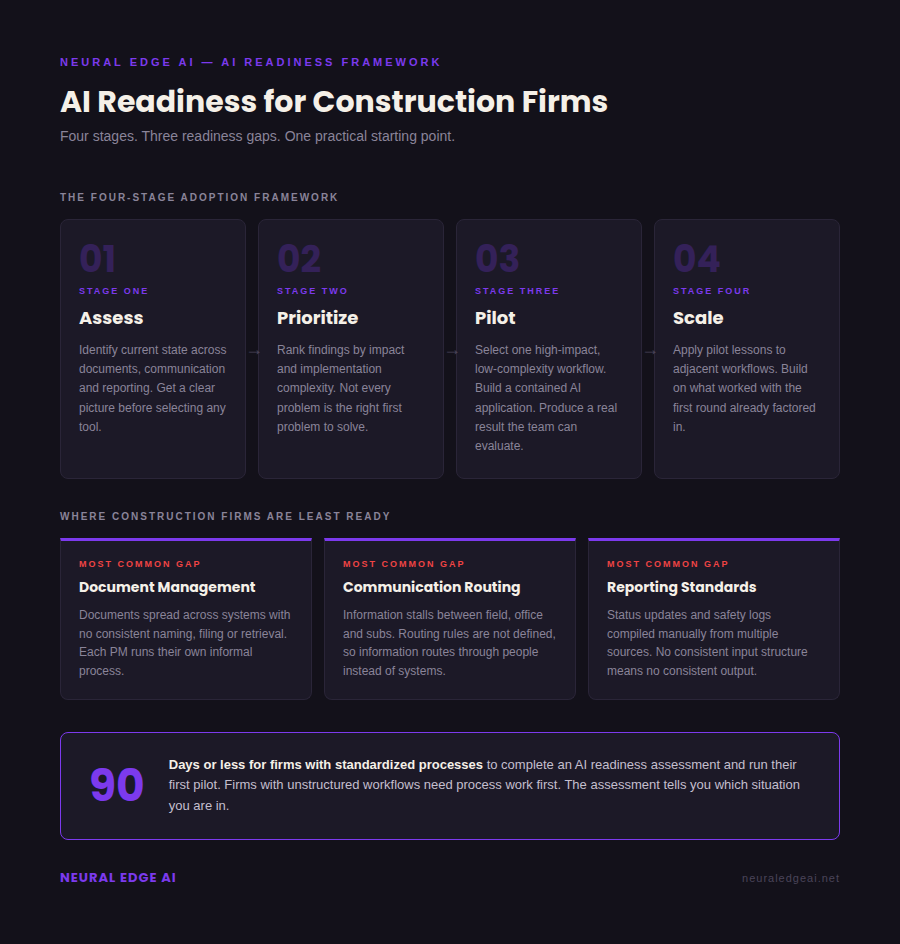
The four stages of AI readiness for construction firms: Assess, Prioritize, Pilot and Scale.
The Construction AI Readiness Blueprint
Neural Edge AI uses a four-stage framework for construction firm AI adoption.
Stage 01
Assess
Identifies your current state across document management, communication and reporting. Produces a clear picture of where your operation stands before any tool gets selected.
Stage 02
Prioritize
Takes the assessment findings and ranks them by impact and implementation complexity. Not every problem is the right first problem to solve with AI.
Stage 03
Pilot
Selects one high-impact, low-complexity workflow and builds a contained AI application for it. Produces a real result your team can see and evaluate.
Stage 04
Scale
Takes what worked in the pilot and applies it to adjacent workflows with the lessons from the first round already built in.
A Practical Example
Consider a hypothetical construction firm running 10 active projects. Their PMs spend an estimated5 to 7 hours per week eachon RFI documentation, submittal tracking and status reporting. Across a team of four PMs, that is20 to 28 hours per weekof coordination work.
An AI readiness assessment for this firm would look at which of those three tasks is most consistent across projects, which has the clearest documentation standards already in place and which produces the most downstream problems when delayed. The answer to those three questions identifies the right pilot workflow.
Three Things to Do Before Your Next AI Conversation
Write down your three most time-consuming documentation tasks.
Note which of those tasks is done the same way by every PM on your team.
Identify one place in your project workflow where a delay in the office creates a problem in the field.
Those three observations are your starting point. They tell you whether your firm is ready to act or whether there is groundwork to do first.
Frequently Asked Questions
What does AI readiness mean for a construction firm?
AI readiness means your core workflows are documented consistently enough for an AI tool to act on them. It also means your team understands the process well enough to evaluate whether an output is correct. Readiness is about process clarity, not technology sophistication.
How long does it take a construction firm to become AI-ready?
The timeline depends on how standardized your current processes are. Some firms complete the assessment and first pilot within60 to 90 days. Others need to address process standardization first. The assessment tells you which situation you are in.
What is the first AI tool a construction firm should adopt?
That depends entirely on your specific operation. There is no universal first tool for every construction firm. The AI readiness assessment identifies which workflow has the right conditions for a successful first pilot based on your actual operation.
Is AI readiness assessment different from an IT assessment?
Yes. An IT assessment looks at your technology infrastructure. An AI readiness assessment looks at your workflows, documentation practices and team capacity. The goal is to determine whether your operation is ready to use AI productively, not whether your network is configured correctly.
Do subcontractors need AI readiness assessments too?
Subcontractors face similar documentation and coordination challenges as GCs. The specific workflows differ but the readiness criteria are the same. If your team spends significant time on manual documentation or coordination tasks, an assessment is worth considering.
What to Do With This Information
If your team is spending significant hours on documentation and coordination every week, the question is not whether AI fits your operation. The question is which part of your operation is ready for it first.
The three observations above will tell you. Most firms find the answer faster than they expect once they actually look.
If you want to know where your operation stands before you spend a dollar on tools, book a free 30-minute discovery call.
Minu Mohan
Minu Mohan is the founder of Neural Edge AI. She has a background in civil engineering and over 20 years of enterprise technology consulting across construction, healthcare, logistics and finance. She works with construction and AEC firms to align their operations before adopting AI.
AI readiness construction firmsconstruction AI adoptionconstruction workflow standardizationAEC technology readiness


Back to top
